The distance between having and proving
Having controls is not the same as demonstrating control.
The company has antivirus, backup and a few policies filed in folders, and it feels protected. Until the day the board, an auditor or the insurer asks for the proof: who has access to what, which assets the company owns, which policy covers that requirement, and how it can show the control was actually enforced. At that moment, scattered control turns into a scramble for evidence no one has ready.
The distance only grows with what the company cannot see. AI adoption spreads across the operation, unapproved tools slip in without passing by anyone, and new access is granted faster than any spreadsheet can track. You cannot demonstrate control over what you do not govern, and what you do not govern is exactly what the auditor asks about first.
Compliance is not owning a policy. It is proving, with current evidence, that the control exists, is enforced and is monitored.
63% of organizations operate without an AI governance policy, even while adopting the technology across the entire operation, according to the IBM Cost of a Data Breach 2025. It is the picture of a wider gap: the company adopts before it governs, and then cannot demonstrate control over what it started using. When the requirement arrives, from the board, the audit or the insurer, what is missing is not the tool, it is the evidence that it is under control.
The market benchmark
The cost of not being able to prove control has already been measured.
is the global average cost of a data breach in 2025, and in the United States it reaches $10.22 million. On top of that come the audits, the fees and the compliance reporting that follow the incident.
IBM Cost of a Data Breach 2025is the average loss of an insured ransomware incident. And insurers no longer accept the policy as a badge: they now require proof that each control was actually enforced and deny the claim when the questionnaire answer did not hold up.
Coalition, 2026 Cyber Claims Reportof the controls in a SOC 2, ISO 27001 or HIPAA audit are organizational: documented policies, access reviews, vendor management and training. It is exactly the evidence that tends to be missing when the auditor asks.
N-able University, Common Requirements for Compliance AuditsThe cost of non-compliance does not arrive only as a fine. It arrives as the contract that falls through because the client required the certification, as the policy that does not pay on the worst day, and as the board's question that goes unanswered.
For decision makers
The same requirement, read from four different seats.
A compliance requirement is not a technical problem. It is a business event, and every chair measures what is at stake with a different question.
The valuation and the risk on your name
A compliance failure is not a bureaucratic detail, it is direct risk to the business and to you: a fine, a lost contract and a due diligence that stalls the sale or the funding at the worst possible moment. Demonstrating control protects the valuation and clears your name of the risk of answering for a failure no one documented.
Evidence ready for every requirement
The corporate client's questionnaire, the insurance renewal and the audit arrive without warning, and each becomes a scramble when the evidence is not ready. A conducted governance trades the scramble for a dossier that is always current, with a known deadline, owner and cost, ready for the board.
The weight of proving
When the auditor arrives, it is your team that drops everything to build the access spreadsheet, hunt for the policy and gather the evidence by hand. Zamak takes on the technical control and the evidence collection alongside your team, so that the audit is a report already prepared, not a week lost.
Governance as a service
You keep the relationship with your clients and expand what you deliver by working together with Zamak: strategic technology direction, asset and identity management and a compliance program at a standard that would be unfeasible to build alone. Your governance portfolio grows without growing your structure.
The Zamak Method
The Zamak Method moves through five continuous movements.
continuous cycle
The cycle is continuous and has no mandatory order: the entry point is the requirement your company faces today. This page covers Compliance, the control that is demonstrated with evidence. Operate, Protect and Recover, which sustain the operation every day, are one click away on the first three cards.
Governance you can prove
What is managed governance and compliance?

The reactive model: anatomy of an audit
The requirement arrives without warning: the client's questionnaire, the insurance renewal or the scheduled audit date.
No one knows for sure which assets the company owns, who has access to what, or where the policy that covers it lives.
The IT team drops everything and assembles the evidence by hand, in improvised spreadsheets, the night before the deadline.
It comes out that the access of someone who already left was never removed, that the policy existed but was not followed, and that records are missing.
The result is the audit finding, the denied claim or the contract that falls through, too late to fix.
The proactive Zamak model, with the evidence always ready
Strategic technology direction maps, from the start, which requirements the company faces and which controls each one demands.
The asset inventory and the access review are kept alive, with least privilege enforced and the access of those who leave removed in time.
Each policy is documented and tied to the requirement it meets, and the evidence that it is being followed is collected continuously.
When the questionnaire or the auditor arrives, the dossier already exists: controls, access, assets and what was remediated, in business language.
The company enters the audit with the evidence ready, and compliance stops being a scramble and becomes a monitored state.
The difference is not owning a policy. It is proving, at any moment, that the control exists, is enforced and is monitored.
Governance and compliance services
Governance is built one track at a time, under one accountable party.
Six managed services cover everything from strategic technology direction to the evidence for each control. Each one is contracted individually, scoped to your environment, and all of them feed the compliance program and the report.
Strategic technology direction
Governance starts with whoever translates technology into a business decision: the risk, the budget and the roadmap led by a dedicated specialist, without the cost of a full-time executive.
Virtual CIO (vCIO)
Strategic technology direction as a service: roadmap, budget, risk management and governance translated into the language of the business and the board.
View serviceVirtual CISO (vCISO)
Security leadership as a service: policy, risk management and audit readiness led by a specialist, without hiring a dedicated executive.
View serviceAssets and identity under control
Every audit starts with two questions: what the company owns and who has access to what. These services keep both answers always ready.
IT Asset Lifecycle Management (ITAM)
The living inventory of every hardware and software asset: what the company owns, in what state and until when, the basis of any audit answer and investment decision.
View serviceManaged Identity & Password Vault (PAM)
Who has access to what, with least privilege and a vault for privileged passwords. It is the number one question of every auditor and every insurer, answered with evidence.
View serviceCompliance and risk governance
With the direction defined and the assets and access under control, the last track ties everything to the requirement: each policy linked to the standard it meets, and the evidence collected continuously.
Compliance Management (GRC)
Governance, risk and compliance in a single panel: policies mapped to each requirement, such as LGPD, SOC 2, ISO 27001 and HIPAA, with the evidence collected continuously, not the night before the audit.
View serviceAI Usage Governance & Shadow IT
Visibility and control over AI usage and over the tools that slip in without approval, shadow IT, to govern, and demonstrate control over, what the company could not see before.
View serviceDiagnostic, execution and proof
How it works in practice.
It is the triad that repeats across the entire Zamak Method: diagnostic, managed service and proof of results.
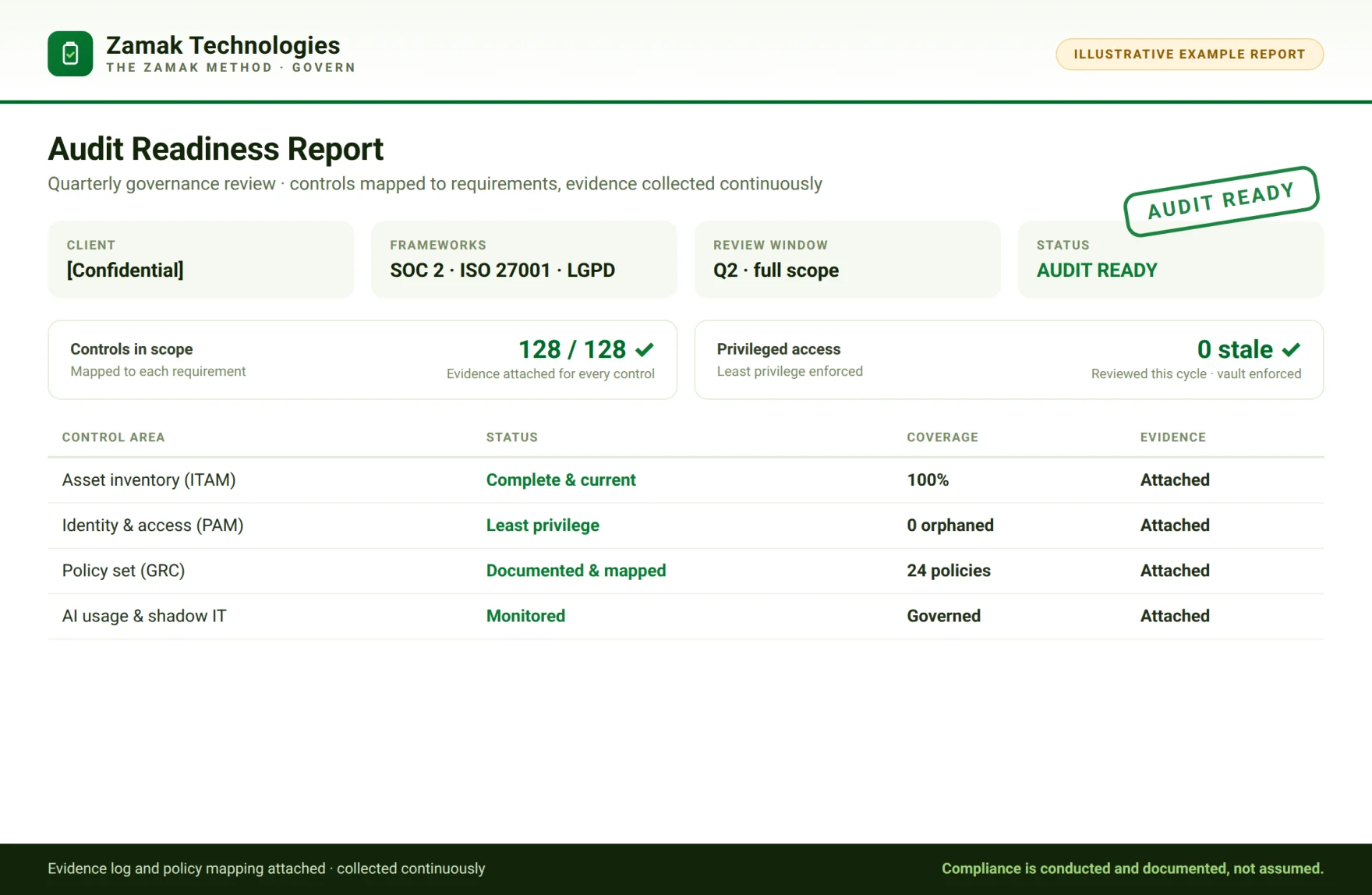 Illustrative examples: audit readiness report and real dashboards of managed governance.
Diagnostic
It starts at no cost and with no commitment: the compliance diagnostic shows, in minutes, where the company is ready and where controls and evidence are missing, mapped to the requirements it actually faces.
Execution
The managed services take over governance: strategic technology direction, asset and identity management and the compliance program, with Zamak answering for the whole.
Proof
With every cycle, a report in business language brings together the evidence of control: who has access, which assets, which policies and what was remediated. The dossier the board, the audit and the insurer ask for.
The outcome
What changes in the business when governance is managed.
Evidence ready
The client's questionnaire, the insurance renewal and the audit stop being a scramble. The dossier of controls, access and assets is always current, ready the day the requirement arrives.
Risk under direction
Strategic technology direction anticipates risk and translates it for the board with priority and cost. The technology decision stops being a reaction and becomes a plan.
Business unlocked
The certification the corporate client requires and an investor's due diligence stop being an obstacle. Demonstrated control becomes a selling point, not a pending item.
Would you rather see first where your company stands for an audit?
Run the free diagnosticWhy Zamak
Companies that must prove control choose Zamak on evidence, not promises.
Zamak Technologies conducts the governance of companies that answer to boards, audits and insurers, with service in Portuguese, English and Spanish and long-standing client relationships. A documented method, strategic direction led by specialists and evidence of control in a report: what this page promises is what your audit finds later.
We operate governance, asset management and identity vault platforms certified to SOC 2 Type II and ISO 27001. Compliance is conducted and documented, not assumed.

Frequently asked questions
What decision makers ask before contracting.
You govern what is inside. Now see what forms outside.
The next step of the method takes the defense beyond your perimeter: monitoring exposed credentials, the brand and the company's digital surface, so that risk is decided before it reaches the operation. Until it arrives, the foundation of governance is the tested continuity that answers for the return when something fails.
The next step
Turn scattered controls into evidence of control.
One assessment conversation is enough to map the requirements your company faces and to design the governance of assets, identity and compliance right for them.
Postponing has a price too: the evidence you lack only shows up as a problem on the day of the audit, the insurance renewal or the client's questionnaire, when there is no longer time to build it.
Schedule an assessment conversation
A conversation in your language to map the requirements and leave with the proposal.
Schedule and get a proposalRun the compliance diagnostic
Minutes to see where your company is ready and where evidence is missing.
Take the free diagnostic