The invisible cost
Reactive IT seems to work, until the day it hands you the bill.
In the reactive model, failure works in silence: the disk degrades, the update slips, the certificate expires. The company finds out through the worst possible channel, with the customer waiting and the team idle, and pays for the problem at whatever size it has grown into.
Recovery itself is rarely in the budget: specialist hours to restore systems, rework for the team and deadlines renegotiated with customers.
Downtime behaves like a pure cost center: it consumes money while producing nothing in return.
Run the numbers for your operation, at whatever scale it runs: for every 25 professionals, with average revenue of $100,000 per person per year, each working day is worth about $400 per person, and eight hours of downtime cost close to $10,000, before any recovery expense. In a 250-person operation, that same stopped day approaches $100,000, while payroll keeps running regardless.
The market benchmark
One hour of downtime has been priced across more than a thousand companies.
is the figure the average cost of a single hour of downtime already exceeds for more than 90% of mid-size and large enterprises.
ITIC 2024 Hourly Cost of Downtime Reportof mid-size and large enterprises estimate the cost of one hour of downtime at between $1 million and $5 million.
ITIC 2024 Hourly Cost of Downtime Reportor more per hour of downtime is the reality reported even by small and mid-size businesses.
ITIC and Calyptix survey, 2025This is not a technology bill. It is the entire payroll running without producing, the sale that does not go through and the customer meeting your competitor while they wait.
For decision makers
The same outage, seen from four different seats at the table.
A stopped operation is not a technical incident. It is a financial event, and every chair reads it through a different set of numbers.
The equity at stake
You spent years building this company. An operation that stops erodes revenue, reputation and, at the moment of a sale or funding round, the valuation itself. Protecting the operation is protecting what you have already built.
A budget without surprises
You prefer a predictable line in the spreadsheet over the risk of an event that costs ten times the budget without warning. Continuous management turns an unpredictable risk into a defined monthly cost.
The backline that multiplies
Your team delivers more when the routine of monitoring, remediation and updates runs on a specialized backline. Zamak works alongside your team, backed by best-in-class technology, and the decisions remain with your leadership.
Expansion with a backline
You keep the relationship with your clients and expand what you deliver by working together with Zamak: NOC, professionals and coverage in the places your operation does not reach yet, so your portfolio grows at your pace.
The Zamak Method
The Zamak Method moves through five continuous movements.
continuous cycle
The cycle is continuous and has no mandatory order: the entry point is the pain your company feels today. This page covers Managed IT, the foundation the rest of the method builds upon.
Continuous management
What are Managed IT Services?

The reactive model
The server disk degrades in silence, with no one assigned to read the signal.
The failure erupts mid-workday and interrupts sales, service and shipping.
The company finds out from the customer, and the ticket goes to a technician who does not know the environment.
The diagnosis starts from scratch, between quotes, approvals and payroll still running.
The operation returns hours or days later, at whatever cost chance determined.
The proactive Zamak model, under continuous management
Telemetry flags the degradation weeks in advance, in a fully mapped environment.
Prevention classifies the risk and schedules the replacement outside operating hours.
The swap happens without interrupting a single minute of the team's work.
The root cause enters the inventory and verification confirms a healthy environment.
The monthly report records the failure that never happened, with the avoided cost documented.
The difference is not the tool. It is having a team watching every day, with the contracted responsibility to act first.
Managed IT services
Managed IT is contracted service by service.
Eighteen managed services, across four fronts, sustain the operation. Each one is contracted individually, scoped to your environment, and all of them feed the monthly report.
Managed IT Operations (NOC)
NOC, short for Network Operations Center, is the operations center that monitors and administers infrastructure continuously. These services place each layer of your environment under that watch:
Managed Servers
Continuous checks that turn into action, disciplined system patching and routine automation across physical and virtual servers.
View serviceManaged Workstations
The workstation estate corrected at scale, with remote repair, standardization and new-machine provisioning.
View serviceManaged Firewalls
Updated firmware, rules and policies under control, a network segmented by VPN (the encrypted remote connection between sites and users), and monitored availability.
View serviceManaged Network Devices
Switches, routers, Wi-Fi, UPS units and printers with inventory, tracked health and up-to-date firmware.
View serviceExtended Web Protection
DNS-layer filtering that blocks malicious sites and phishing before the page opens, inside and outside the network.
View serviceCo-Managed Platform Access
Your team on the same operations console Zamak uses, with roles, permissions and scope isolated to your environment.
View serviceSecure Remote Access
Professional reach to any computer in seconds, with encrypted connection and two-step authentication.
View serviceCloud
It is where your operation runs, from daily collaboration to the datacenter. Zamak sizes, governs and operates:
Microsoft 365 for Business
The right plan in the Business line for up to 300 users, with Business Premium security switched on and operated.
View serviceMicrosoft 365 for Enterprise
E3 and E5 plans defined by user profile, with the security platform operated under co-management.
View serviceManaged Public Cloud (Azure)
The Azure environment provisioned, governed and operated, with cost control and a monitored security posture.
View serviceManaged Private Cloud (Tier III)
Dedicated compute, memory and storage in a Tier III datacenter (the international standard for redundancy and uptime), operated by Zamak at a fixed cost.
View serviceManaged Service Plans
On top of the managed services, the level of care your structure calls for, on a ladder that grows with the company:
Managed NOC & SOC
The foundation of the plans: the environment operated by a network operations center (NOC) and protected by a security monitoring center (SOC), assembled from the services your company selects.
View serviceCo-Managed Essential Plan
The backline specialist for companies that already have an IT team, with unlimited hours of care and a response start within 8 business hours.
View serviceCo-Managed Advanced Plan
Engineering shoulder to shoulder with your technical team's routine, the backline specialist behind it, and a response start within 5 business hours.
View serviceDedicated IT Care
The most complete level of care, from first response for users to the backline specialist, with on-site presence and a priority start within 2 business hours.
View serviceExtended IT Team
Human capacity alongside your team, at the level and for the time the operation requires, never in its place:
Dedicated IT Professional
A professional dedicated to your operation, from junior to manager level, backed by Zamak's entire structure.
View serviceIT Hour Bank
Seniority on demand, from technician to director, paying only for the level and the hours you use.
View serviceVacation & Absence Cover
When someone on your IT team is away, Zamak covers the post at the right level and hands it back organized.
View serviceDiagnostic, execution and proof
How it works in practice.
It is the triad that repeats across the entire Zamak Method: diagnostic, managed service and proof of results.
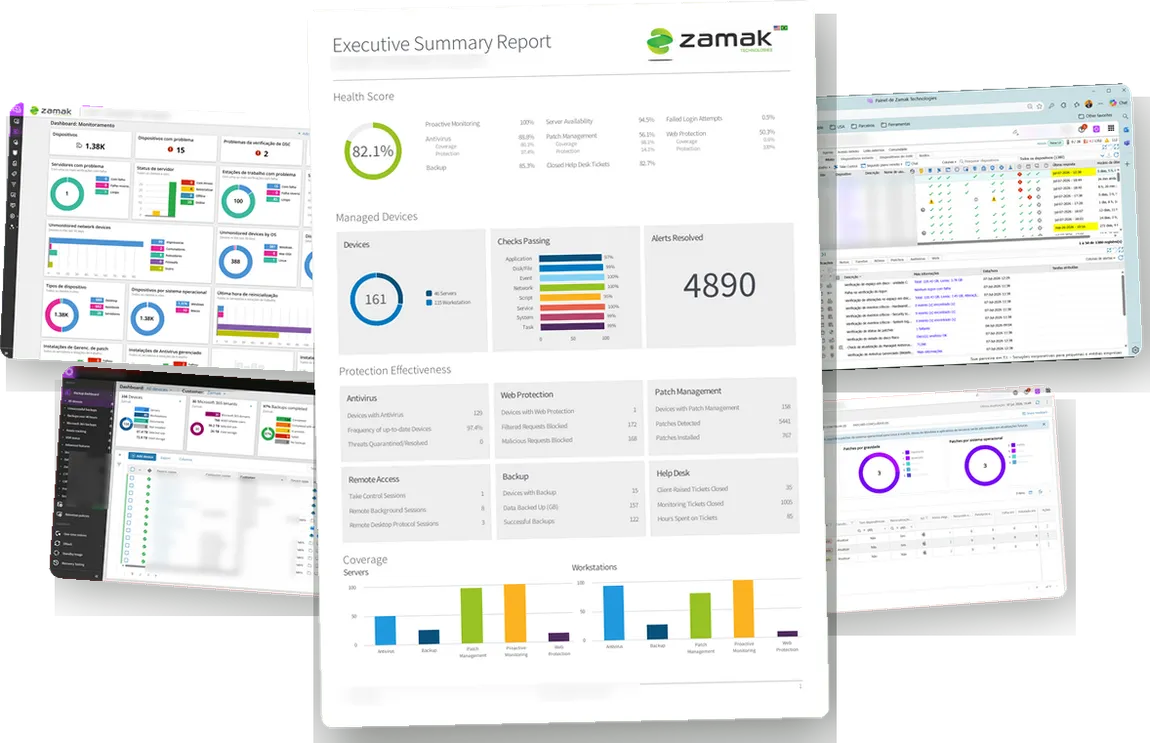 Illustrative examples: executive report and real managed operations dashboards.
Diagnostic
It starts at no cost and with no commitment: the calculator sizes what one hour of downtime costs your operation, and the free self-assessment maps the environment's blind spots.
Execution
The managed services take over the routine: monitoring, remediation, updates and care at the contracted level, with Zamak answering for the whole.
Proof
Every month, a report in business language records what was prevented, what was fixed and where the environment evolved. Evidence that serves the board, the audit and the insurer.
The outcome
What changes in the business when the operation is managed.
Protected revenue
Prevention acts before the failure and the operation keeps selling, serving and shipping. Downtime stops being an invisible line in the results.
Predictable cost
A defined monthly fee replaces the unpredictable event. The technology budget becomes a stable line in the spreadsheet, without emergency spikes.
Evidence on hand
A monthly report and documented inventory answer customers, audits and insurers the day the question arrives, without a scramble.
Would you rather see this calculation applied to your own operation's numbers?
Schedule a meetingWhy Zamak
Companies that cannot stop choose Zamak on evidence, not promises.
Zamak Technologies runs technology for companies that cannot stop, with service in Portuguese, English and Spanish and client relationships that span more than a decade. A documented method, a monthly report in business language and verifiable credentials: what this page promises is what your audit finds later.



We operate with tools certified for SOC 2 Type II, ISO 27001, HIPAA and PCI-DSS.

Frequently asked questions
What decision makers ask before contracting.
Monitored is not the same as defended.
The next step of the method places the company under continuous defense, with detection and response. Start by measuring your security posture.
The next step
Bring predictability to your operation.
One assessment conversation is enough to design the scope, the care model and the best entry path for your company today.
Postponing has a price too: every month in the reactive model is a month paying payroll to wait for the next failure, with no prevention, no report and no one answering for the whole.
Schedule an assessment conversation
A conversation in your language to design the scope and leave with the proposal.
Schedule and get a proposalCalculate the cost of downtime
Three minutes to see the cost of one hour of downtime and get the report.
Open the calculator