The false sense of security
Having a backup is not the same as being able to recover.
The company runs a backup every night and sleeps well. Until the day it needs that backup and finds out the copy sat on the same network the attack encrypted, that the file that mattered never made it into the routine, or that no one ever tested whether it actually comes back. A backup no one proves is a promise, not a protection.
The cloud reinforces the illusion. Microsoft 365 keeps the service up, but recovering your data has an expiration date, and a virtual machine snapshot, the picture of the machine's state, lives in the same place as the machine itself. When the environment goes down, both go down together.
Continuity is not owning a copy. It is owning a copy that is isolated, immutable and tested, with a return time defined before the failure.
Only 54% of companies hit by ransomware in 2025 managed to restore from their own backups, the lowest rate in six years, according to Sophos, The State of Ransomware 2025. Almost half could not: the copy was in the line of fire, incomplete or never tested. What separates the company that recovers from the one that pays the ransom is not having a backup, it is having a copy that is isolated, immutable and proven to restore.
The market benchmark
The cost of going down has been measured across thousands of companies worldwide.
is the average cost to recover from a ransomware attack, excluding the ransom, adding up downtime, rebuilding and the hours of getting back on track.
Sophos, The State of Ransomware 2025of ransomware attacks tried to compromise the victim's backups, and 57% of those attempts succeeded. When the backup goes down with everything else, the recovery bill runs up to eight times higher.
Sophos, The Impact of Compromised Backups on Ransomware Outcomesis the level the cost of a single hour of downtime already exceeds for more than 90% of medium and large enterprises. Every hour offline has a price.
ITIC 2024This is not a technology bill. It is cash flow on hold, the order that goes unbilled, the customer who calls a competitor and payroll coming due while the systems stay down.
For decision makers
The same outage, read from four different seats.
An outage is not a technical problem. It is a business event, and every chair measures the damage with a different question.
The survival of the business
A disaster with no way back is not a scare, it is an existential risk: client data lost, contracts left unfulfilled and a valuation that collapses at the worst possible moment. Having the way back planned and tested is protecting what your company took years to build.
Return time on the spreadsheet
Every hour of downtime has a cost, and improvisation turns hours into days. A defined return time trades the unpredictable disaster for a plan with a known deadline, cost and owner, ready for the board.
The pressure of the disaster day
On the day of the failure, it is your team that responds under pressure, without sleep, with the board asking questions. Zamak takes on the isolated backup, the recovery testing and the return plan alongside your team, so that recovery is a known procedure, not a night of improvisation.
Continuity as a service
You keep the relationship with your clients and expand what you deliver by working together with Zamak: managed backup, tested recovery and disaster recovery at a standard that would be unfeasible to build alone. Your continuity portfolio grows without growing your structure.
The Zamak Method
The Zamak Method moves through five continuous movements.
continuous cycle
The cycle is continuous and has no mandatory order: the entry point is the pain your company feels today. This page covers Continuity, the return designed before the failure. Cybersecurity and Managed IT, which sustain the operation every day, are one click away on the first two cards.
Planned continuity
What is managed Backup and Disaster Recovery?

The reactive model: anatomy of an outage
The backup runs every night and no one checks it: the routine fails in silence, or copies data that was already corrupted.
The copy sits on the same network as the operation, within reach of the same attack and the same hardware failure.
On the day of the disaster, restoration starts from scratch: reinstalling systems, reconfiguring services and recovering file by file, under pressure.
Hours turn into days, and no one can tell the board when the operation comes back.
It is discovered, too late, that the backup was incomplete, corrupted or had never been tested.
The proactive Zamak model, with the return designed
The copies live isolated and immutable, out of the attack's reach, and the routine is monitored every day.
Recovery is tested in a separate environment before the incident, with documented proof that the systems actually start.
The continuity plan defines the return time and the order in which each system comes back, sized to what the operation can tolerate.
On the day of the disaster, the return is a known procedure: the environment comes up in a managed cloud, most critical systems first.
The operation comes back online within the planned time, and the board follows, step by step, what has already returned.
The difference is not making a backup. It is proving that it comes back, within a time defined before the failure happens.
Backup and continuity services
Continuity is contracted layer by layer.
Seven managed services cover everything from the isolated copy of each piece of data to the full return of the operation in a managed cloud. Each one is contracted individually, scoped to your environment, and all of them feed the continuity plan and the report.
Isolated, immutable backup
The first foundation of continuity is a copy the attack cannot reach: independent from your environment, immutable (it cannot be altered or deleted) and out of the line of fire. Each type of critical data gets its own dedicated copy.
Microsoft 365 Backup
An independent, isolated and immutable copy of email, files, SharePoint and Teams. What sits in Microsoft's cloud stops being your only copy.
View servicePhysical Server Backup
The whole server copied out of the line of fire. When the disk fails or an attack encrypts everything, the operation is restored from the copy, on the same equipment or another, without rebuilding from scratch.
View serviceVirtual Server Backup
A snapshot is not a backup: it lives in the same place as the virtual machine. This is an independent copy of each virtual machine, outside the host, that comes back even when the host goes down.
View serviceWorkstation Backup
The work that never reaches the server, protected on each person's computer. If the machine is lost or locked by an attack, the work comes back whole.
View serviceOffice Document Backup
Contracts, spreadsheets and proposals with an isolated copy and version history. The document that only existed on one workstation stops being your only copy.
View serviceTested recovery and continuity
A stored copy is not yet an operation back on its feet. These services prove the backup truly returns and put the company back online when the worst happens.
Disaster Recovery Testing
The proof that the backup comes back: brought up in an isolated environment, with a date and a screenshot. You stop hoping the backup works and start knowing that it does.
View serviceDisaster Recovery as a Service (DRaaS)
The entire environment ready to switch on in a managed cloud. When disaster strikes, the operation comes back through the cloud, most critical systems first, without you keeping a second data center.
View serviceDiagnostic, execution and proof
How it works in practice.
It is the triad that repeats across the entire Zamak Method: diagnostic, managed service and proof of results.
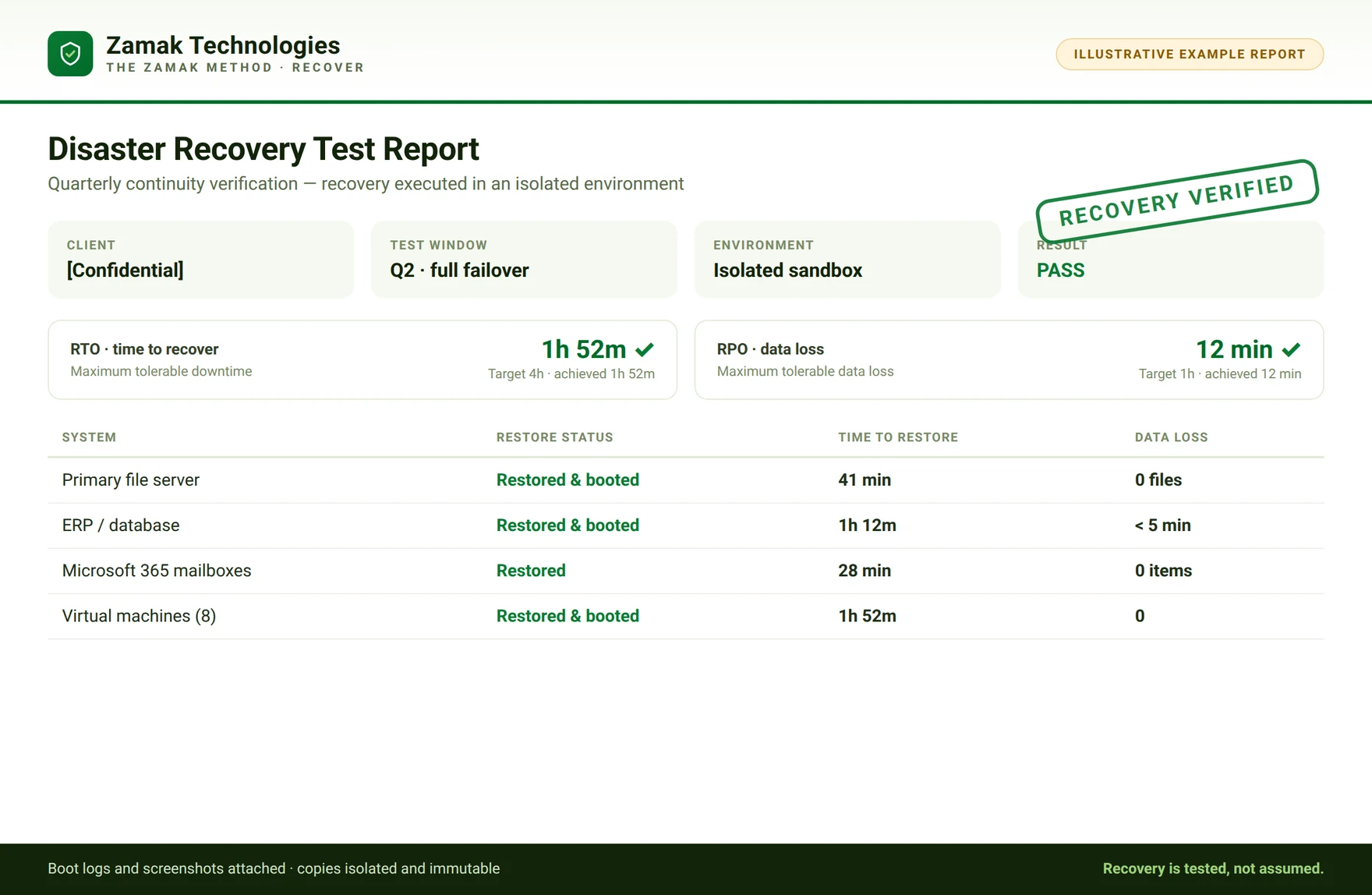 Illustrative examples: recovery test report and real dashboards of managed continuity.
Diagnostic
It starts at no cost and with no commitment: the Microsoft 365 backup checker shows, item by item, what native retention does not protect, and the ransomware resilience diagnostic measures your recovery line in minutes.
Execution
The managed services take over continuity: isolated and immutable backup, recovery testing and disaster recovery at the contracted level, with Zamak answering for the whole.
Proof
With every recovery test, a report in business language records that the systems come back, within the defined time. Evidence that serves the board, the audit and the insurer.
Check your Microsoft 365 backupMeasure your ransomware resilience
The outcome
What changes in the business when continuity is managed.
Return with a deadline
Improvisation becomes a procedure: a defined, tested return time replaces the question “when do we come back?” with an answer known before the failure.
Predictable cost
A defined monthly subscription takes the place of the loss from a long outage. The continuity budget becomes a stable line, sized by real risk.
Proof for those who demand it
Board, audit, corporate customer and insurer receive the evidence that the operation comes back, the day the questionnaire arrives.
Would you rather discuss how long your operation can actually stay down?
Schedule a meetingWhy Zamak
Companies that cannot stop choose Zamak on evidence, not promises.
Zamak Technologies keeps companies that cannot stop up and running, with service in Portuguese, English and Spanish and client relationships that span more than a decade. A documented method, continuity conducted by specialists and recovery proven in a report: what this page promises is what your audit finds later.



We operate backup and recovery technology built on isolated, immutable copies, certified to SOC 2 Type II, ISO 27001, HIPAA and PCI-DSS. Recovery is tested, not assumed.

Frequently asked questions
What decision makers ask before contracting.
Back online. Now prove it and formalize it.
The next step of the method turns continuity into evidence of control: your company demonstrates to the board, the audit and the insurer that it manages assets, identity and compliance with strategic technology direction. Until it arrives, the foundation of the way back is the continuous defense that reduces the chance of the failure happening.
The next step
Design your company's way back before the next failure.
One assessment conversation is enough to measure how long your operation can tolerate being down and to design the backup, the recovery testing and the continuity plan right for today.
Postponing has a price too: every week without a tested continuity plan is a bet that the disaster will not arrive before you are ready for it.
Schedule an assessment conversation
A conversation in your language to design continuity and leave with the proposal.
Schedule and get a proposalCheck your Microsoft 365 backup
Minutes to see, item by item, what native retention does not protect.
Take the free test