The world of a life sciences company
Years of work live inside systems, and every stage depends on them
In the lab, an experiment generates the data that underpins a patent. On a validated spreadsheet, a trial's results wait for submission to the regulator. On a server, the formula that took years and millions to reach this point. In an exchange with a research partner, part of that knowledge leaves your walls because the project needs it to. Each of those fronts runs on technology, and it is that entire foundation Zamak holds up: the research that cannot leak, the regulated operation that has to stay up and running, the recovery for when something fails and the compliance the market and the regulator now demand.
Where it really hurts
The threat is not only IT. It hits your edge, your submission and the trust of your investors, all at once.
An incident at a life sciences company rarely takes just one file. It hits three fronts at once, and each one exacts a different price.
What they can take
The formula, the trial data, the submission dossier. Years of research a competitor or a criminal group would carry off in minutes, and that, once out, do not come back in.
The fear that lingers
It is not only the ransom. It is the chance of seeing your discovery published ahead of your patent, the trial delayed and the investor pulling back on the next round because your security did not pass their review.
What science should not tolerate
A company that brings rigor to the lab should not entrust the result of a decade to an improvised control. Method at the bench and improvisation in technology do not belong in the same operation.
The question that stays
Your company's most valuable asset is not on the balance sheet: it is a formula, a trial's data, years of research that today fit in a single file. That is exactly what an attack comes looking for. How much of your next discovery could already be beyond your walls?
It is not a question about servers, it is a question about what gives your company its value. And it deserves an answer you can verify, not one you hope is true.
An X-ray of the life sciences sector
Where the value of your research moves, and where an attack tries to intercept it
At a life sciences company, what holds value is not idle money: it is knowledge, regulated data and access to the people who know. We walk the four points this value moves through, because those are the ones an attack aims for.
The research and the IP
The formula, the experiment data and the submission dossier are the most valuable thing your company holds.
If it fails: One exfiltration is enough for years of advantage to surface on a criminal forum or in a competitor's hands.
The regulated data
Trial results and records have to stay intact and traceable to support the approval.
If it fails: A tampered record or an unvalidated system delays the submission and can cost the approval itself.
The chain of partners
Contract research labs, manufacturers, suppliers and engineering firms all touch part of your knowledge.
If it fails: Each access is one more door, and the attack usually comes in through the weakest link in the chain.
The access of those who know
Researchers, partners and former staff know where the value is kept.
If it fails: An access not revoked in time becomes the quiet exit of your most expensive asset.
Zamak treats the four points as one defense system, not as isolated fixes that leave gaps between them. That is how the knowledge stays yours, and only in the hands of those allowed to hold it.
What's at stake
What is lost when years of research become the most coveted target of digital crime
That was the volume of drug development and research data a ransomware group claimed to have exfiltrated from Inotiv, a contract research organization, in an attack the company confirmed to the SEC in August 2025. Source: Inotiv's 8-K filing with the SEC; volume claimed by the Qilin group.
Ransomware is present in 88% of breaches at smaller companies, against 39% at large ones. The attack does not choose by size, it chooses by a lowered guard. Source: Verizon DBIR 2025.
Of all attacks on the life sciences sector in 2025, ransomware was the single largest threat, ahead of data breaches. Source: XeneX SOC, analysis of attacks on the life sciences sector in 2025.
The number that breaks the sector's most dangerous myth: that espionage and ransomware are only a big-pharma problem. No size protects a company holding something this valuable. From the single-molecule startup to the multinational, the target is the research, and the one who comes out ahead is not the largest, it is the one that arrived prepared.
A day at your company
The work moves at the pace of science, right up to the point where technology fails
A day at a life sciences company is a race against the clock and against the competition. See where a single incident cuts in and stops everything, and where Zamak rewrites the ending.
The submission clock is already running. The team has to close the data package by end of day or miss the window with the regulator.
An investor confirms a due-diligence visit for next week and asks, by email, for evidence that your security is in order.
The manufacturing partner is waiting on the agreed access to start the next stage. Every hour of delay pushes the whole schedule back.
A well-crafted email, a forgotten access, a ransomware attack. The systems freeze and the data starts to leave.
With Zamak, the day ends differently. The threat is detected and contained before it spreads, the research stays protected, the regulated operation carries on and the work keeps the pace science demands.
The turning point
The problem was never your science. It was a technology model that only reacts after the damage is done.
Most life sciences companies live with an IT model that only acts after the fact: once the formula has already walked out the door, once the system holding the trial has already stopped, once the auditor has already flagged the gap. Zamak changes that logic. We come in as the backstop that acts before, alongside whoever already looks after your technology, so the incident never gets the chance to happen. There is a method behind it, and it comes down to three steps.

The Protected Discovery Plan
See what is at risk
In an initial conversation, we map where your research can leak, where the operation can stop and where the regulated data can lose its integrity. You leave that conversation with a clear picture of where you are exposed.
Protect and sustain
We lock down access to your research, keep the operation running without downtime, with tested recovery, and monitor it all day and night from a dedicated operations center.
Discover with peace of mind
Your company goes back to focusing on the science, faces the regulatory audit with the evidence already gathered and moves forward on the research it managed to protect. It is where all of this leads, not one more item on your agenda.
From the first conversation to the ongoing follow-up, you have a partner at your side who understands the value of your research, not only the technology that guards it.
For every front of your company
The same protection, speaking to each person who makes the discovery happen
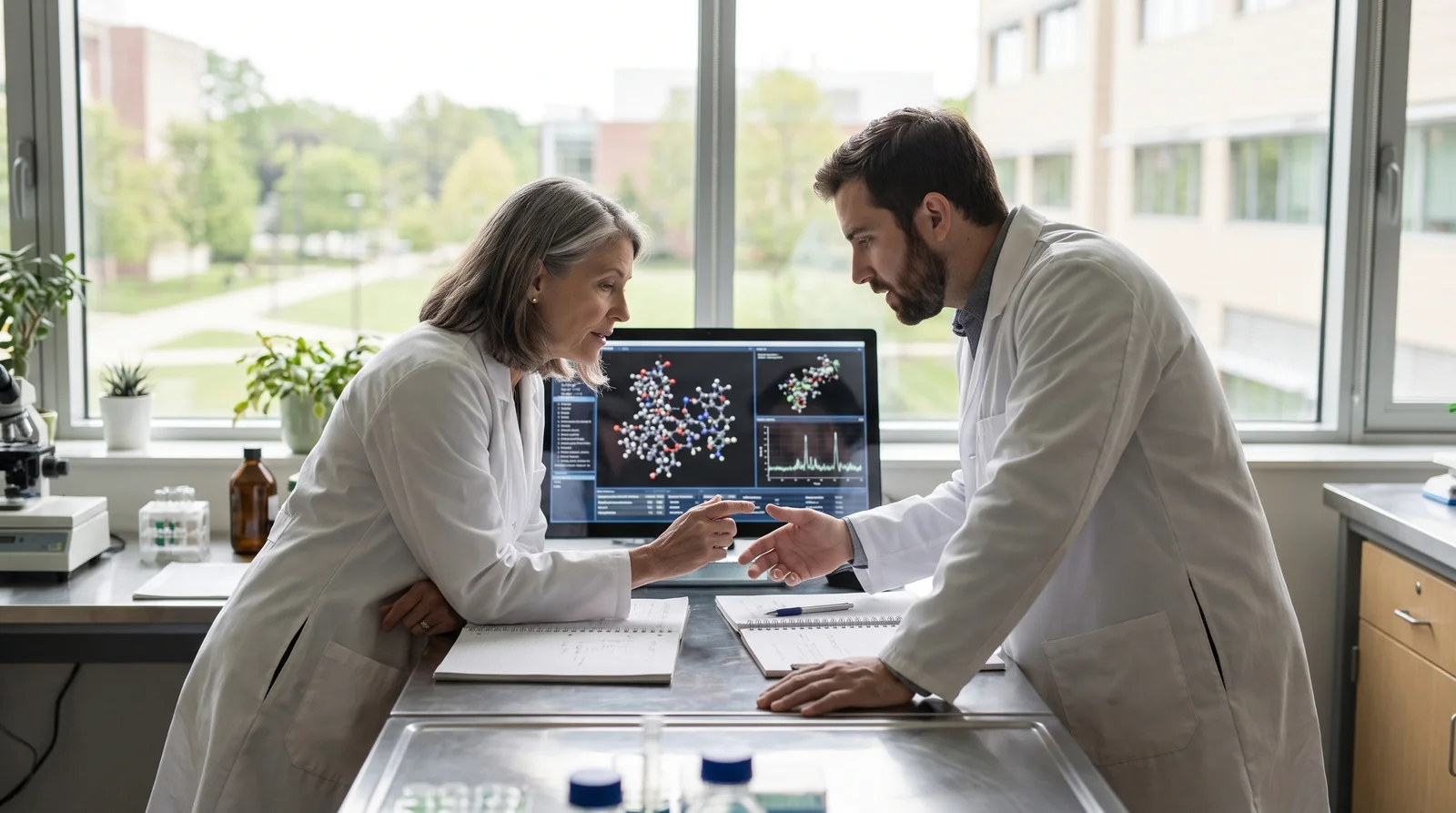
The people in the scene at the top are not extras: they are the ones who research, who lead and who keep the operation running, each with a fear of their own facing the same risk. Zamak speaks to all of them, without taking the lead role from anyone.
Compliance as the path to approval
Make regulatory compliance an argument in your favor, not an obstacle to discovery
In life sciences, proving your technology is under control stopped being paperwork: it became a condition to submit, to close with a partner and to raise the next round. That is why Zamak offers a readiness service: it maps your gaps against the standards your market recognizes, keeps your evidence continuously collected and prepares your operation for the regulatory audit and the partner review.
GxP and data integrity
The set of good laboratory, clinical and manufacturing practices, and the principle that every piece of data supporting a decision has to be intact and traceable. It is what gives your submission its credibility.
Computerized system validation
The assurance that the systems recording and processing your data do what they should, the documented way. It is the standard of 21 CFR Part 11 in the United States and of Annex 11 in Europe, depending on the market where you submit.
ISO 27001
The international standard for managing information security. It is the credential a research partner or a large client audits before exchanging sensitive data with you.
GDPR and LGPD
The laws that govern personal data in the markets you operate in, the Brazilian and the European among them. Trial participant and patient data demand that rigor wherever they are handled.
The compliance stays yours; with Zamak, keeping it in order and having the evidence ready to present stops taking your time away from the science. The first step is a no-cost assessment against the standard that weighs most in your case, and from there it continues as an ongoing engagement.
What changes in practice
A life sciences company that discovers with the calm of having protected what matters
When the technology foundation stops being a silent risk and becomes a protected asset, the difference shows up in the daily life of whoever runs the research and the business.
The research stays protected
The formula, the data and the IP stay guarded, isolated and encrypted, away from the competitor and from anyone without permission.
The operation does not stop
The systems that support the lab and the submission stay up, with tested recovery for the day something goes off script.
The review is calm
The compliance evidence and the validation are ready and organized, and the regulator's or the partner's review stops being a race against the clock.
Trust becomes investment
On a solid foundation, your company passes the investor's security review and grows on the discovery it managed to protect.
Proven trust
A company in the life sciences chain that entrusted its technology to Zamak

Engenews, specialized in pharmaceutical engineering, is among the companies that entrusted the protection and continuity of their technology to Zamak Technologies. In a sector where knowledge is the main asset, looking after the technology of those who support the science is the proof that matters most to us.
Zamak's credentials
You do not have to take our word for it alone. The credentials speak for us.
Zamak Technologies operates on a technology and security foundation that carries the same certifications the market demands of the vendors serving anyone who works with sensitive data.
Microsoft Solutions Partner
A partnership that attests to Zamak's competence in Microsoft 365 environments, the base of your team's work.
Addee Elite Group
Top of the partner program of N-able's exclusive distributor in Brazil, a reference in data resilience.
Great Place to Work
Certification that Zamak is built by people who stick around, which translates into continuity for those who trust us.
BACCF member
Brazil-Florida Chamber of Commerce, with an operation ready to serve your business across the Americas.
We operate with tools certified in SOC 2 Type II and ISO 27001, the same seals a research partner or an investor looks for when auditing the chain of those who guard your data.
Before you ask
Cybersecurity and managed IT for biotech and life sciences: protected research, a regulated operation up and running and evidence ready for the audit
Cybersecurity and managed IT for biotech and life sciences is the service that protects the research, formulas and trial data of a biotech company, keeps its regulated operation running, runs isolated backup with tested recovery and keeps compliance and validation evidence ready for the regulatory audit and partner reviews. Zamak Technologies delivers that coverage as a single partner, from biotech startups to large pharmaceutical operations, across the Americas.
Where to go next
Go deeper on what weighs most for your life sciences company
The conversation that protects your discovery
Let's protect what your science took years to discover
An initial conversation, no strings attached, to map where your research and your operation are exposed and what to do about it. From those who look after technology to those who turn research into discovery.
Book the first conversation